
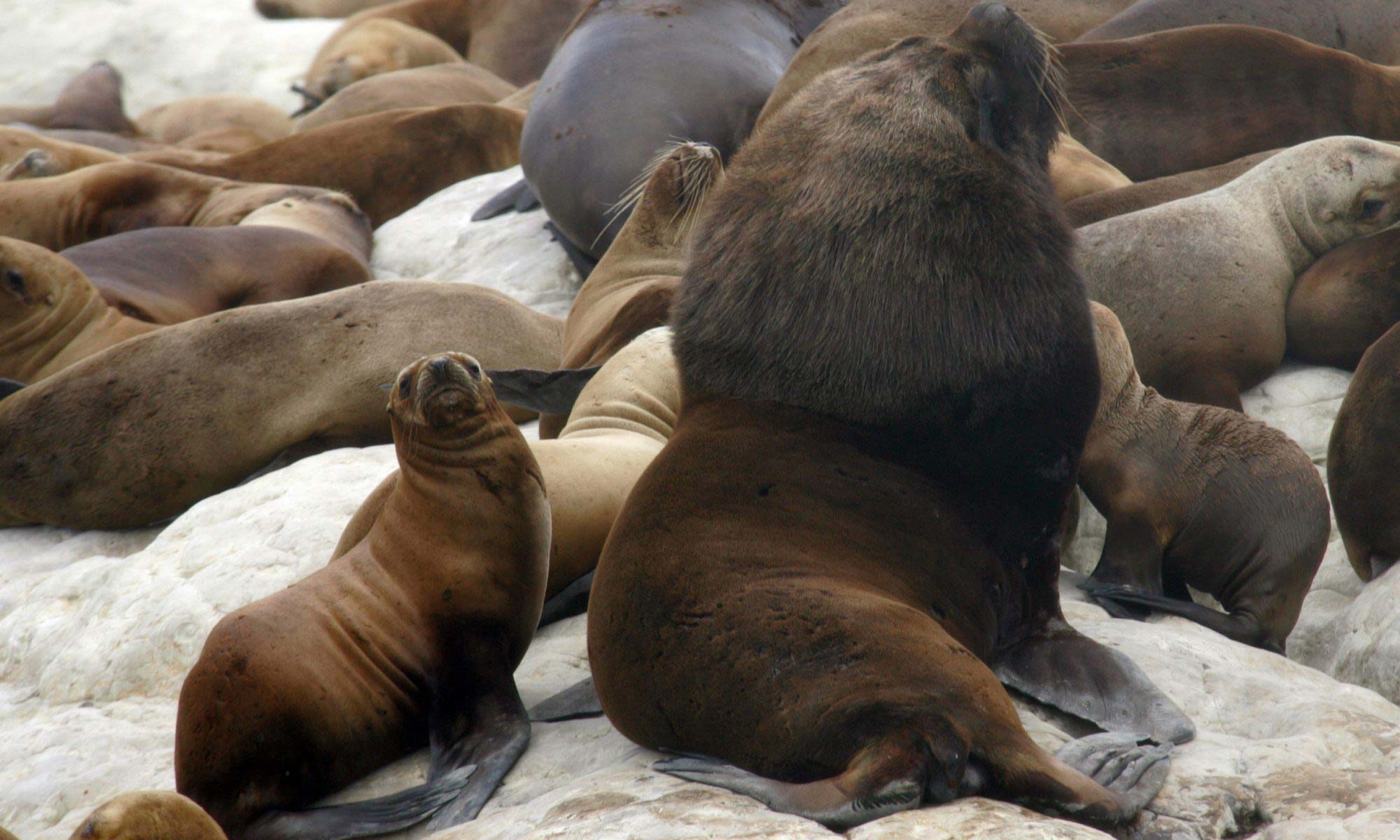
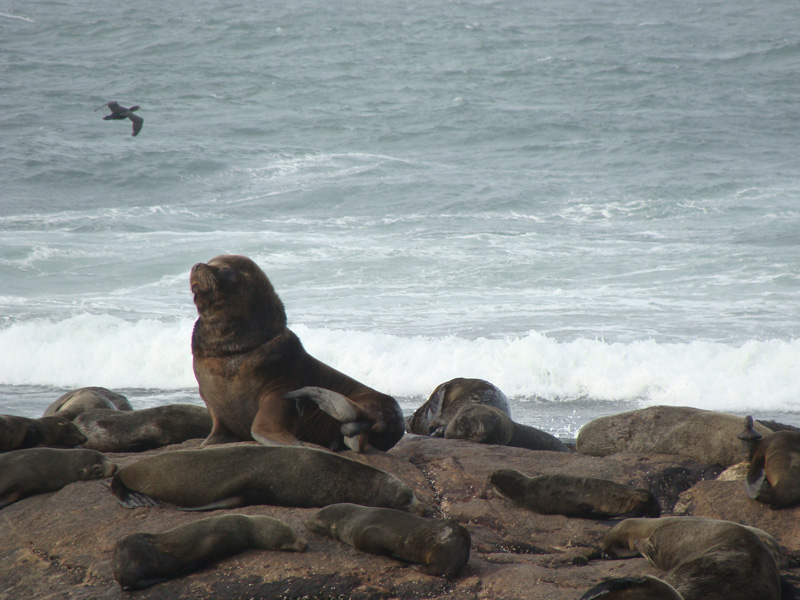
Seals – Southern sea lions (Otaria flavescens) belong to the eared seal family and are also known as South American sea lions. Their range extends across the Atlantic and Pacific coasts of South America from southern Brazil, through Argentina and Chile, to southern Peru and the Falkland Islands.
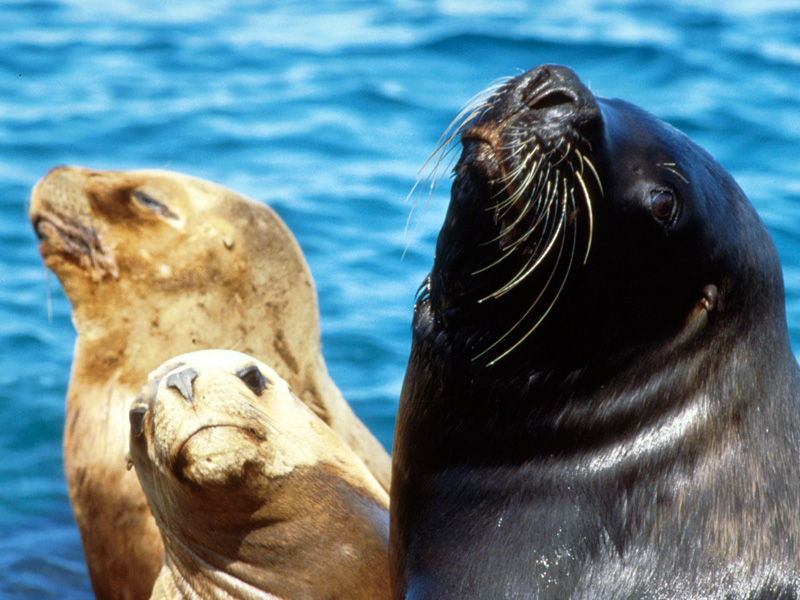
As with all eared seals, male mane seals are significantly larger than females. Males can weigh up to 350 kg and measure over 2.5 m in length, while females only weigh up to approx. 150 kg. Males have a distinctive mane, which is usually lighter in color.
The mane seals live together in colonies in so-called harem groups. During the mating season in the Australian summer (December-February), bulls gather up to ten females around them and defend their harem against competing bulls.
Males and females differ not only in weight and body size, but also in their hunting behavior. In general, South American sea lions feed mainly on benthic fish. While females usually hunt in coastal areas, males dive much deeper and further away from the coast to catch fish. The seals' sensory hairs—known as vibrissae—are able to detect the slightest disturbances in the water. This enables South American sea lions to find their prey even in the dark or in murky waters.
Maned seals were hunted intensively, especially at the beginning of the 19th century, which caused the global population to decline dramatically. They are now protected everywhere and the population has recovered. The maned seal is classified as not endangered by the IUCN.
Seal Project | 30 Years of YAQU PACHA e.V. | Videos | Membership | Summary of a Successful Workshop | Report on Our Workshop Day 2 | YAQU PACHA e.V. Board of Directors | Species Conservation | Animal Species Protected by YAQU PACHA