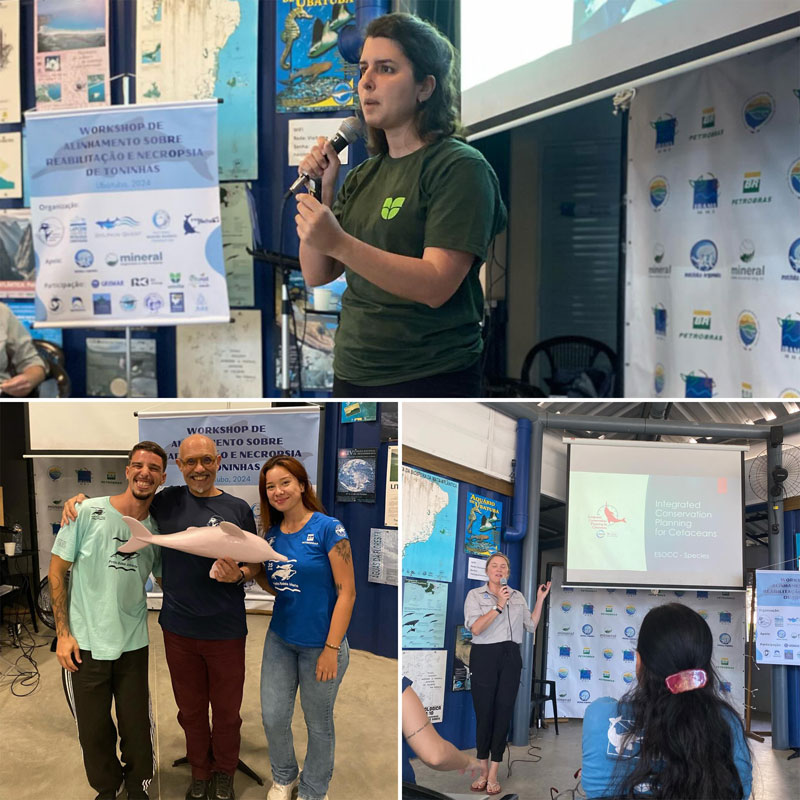

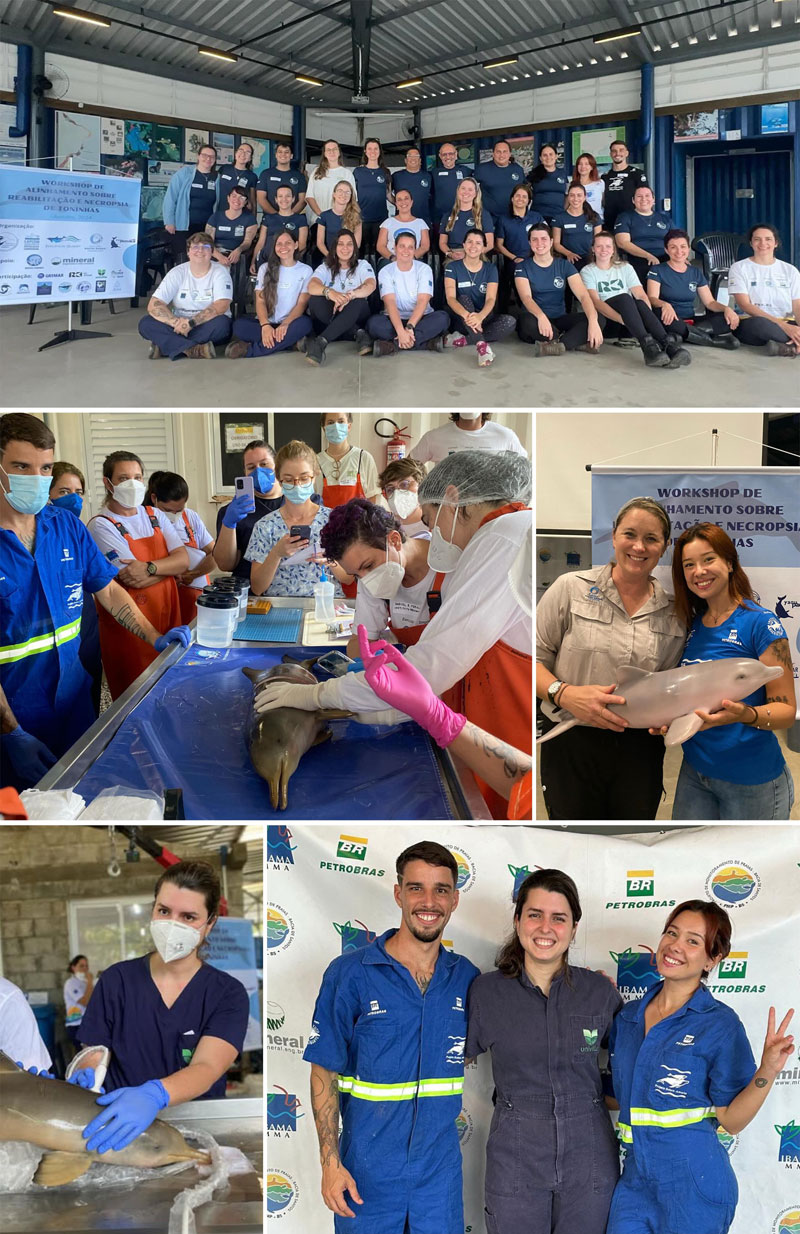
Ubatuba, Brazil – From November 8 to 10, the Alliance for the Franciscana Dolphin Conservation Research, Rescue, and Rehabilitation (AFCR3) hosted a groundbreaking workshop at the Instituto Argonauta to advance conservation efforts for the Franciscana dolphin (Pontoporia blainvillei). Led by Dr. Jenny Meegan of the National Marine Mammal Foundation (NMMF) in the U.S. and Dr. Aricia Benvenuto of the University of São Paulo in Brazil, 24 participants from various Brazilian institutions came together to address basic rehabilitation techniques and standardized necropsy protocols.
The workshop focused on two critical needs: the rehabilitation of stranded Franciscana dolphins, from newborns to adults, and the ability to perform standardized necropsies to identify threats and causes of death. The training was based on scientifically sound protocols developed by the Alliance, a collaborative network of over 34 veterinarians, biologists, nutritionists, and zootechnicians from Argentina, Uruguay, Brazil, the United States, Spain, and Germany.
An Urgent Need for Action
The Franciscana dolphin is listed as Endangered on the IUCN Red List of Threatened Species due to widespread threats such as bycatch, habitat loss, and pollution. In Brazil, however, the species is even more critically endangered and is listed as Critically Endangered (CR) on the country’s national Red List. The high number of live strandings underscores the urgent need for qualified rehabilitation measures, while necropsy data are essential for understanding and addressing the causes of mortality.
“Workshops like this aren’t just about saving individual animals; they’re about securing the future of a species,” says Dr. Jenny Meegan. “From our perspective, this is an opportunity to combine global expertise with local conditions. Collaborations like this allow us to share advanced veterinary techniques and rehabilitation protocols developed at the international level and ensure that this knowledge is available to those who need it most. The conservation of the Franciscana dolphin is a global effort, and every effort, no matter where it comes from, contributes to the survival of this species. The NMMF has learned a great deal through collaboration with conservation teams in other countries, and we are honored to support the incredible work being done here in Brazil.”
Dr. Aricia Benvenuto emphasized the local perspective: “In Brazil, the Franciscana dolphin is an important part of our marine biodiversity, and its endangered status is a call to action for all of us. This workshop is crucial because it provides local experts with the tools and knowledge they need to respond effectively to strandings and conduct meaningful necropsies. Strengthening Brazil’s capacity to rescue and protect marine mammals is crucial for the survival of this species. As someone who works directly with the marine ecosystems where these dolphins live, I see the urgent need for collaborative efforts like this one. Together, we can ensure that conservation is not just a concept, but is put into practice in the regions where it is most urgently needed.
Why this workshop is important:
Allianz's commitment to the conservation of the Franciscana dolphin relies on a multifaceted approach, and this workshop is an example of its goals:
- Improving Rehabilitation Outcomes: The training enables participants to provide proper care for stranded dolphins, thereby increasing their chances of survival.
- Well-founded conservation strategies: Standardized necropsies provide important data for combating anthropogenic threats, ranging from fishing practices to environmental toxins.
- Global Collaboration: The workshop underscores the Alliance's commitment to cross-border knowledge exchange and the promotion of international collaboration to save species.
About Allianz
The AFCR3 was founded in 2019 with the goal of assisting with live strandings, providing essential equipment and expertise, and empowering conservationists through training. The founding members, YAQU PACHA and the Nuremberg Zoo, coordinate the alliance’s activities with other institutions and advance the mission to protect the Franciscana. Many nongovernmental organizations and universities from South America, such as Fundación Mundo Marino & Aquarium (Argentina), Karumbé & RENACE (Uruguay), the University of São Paulo, Biopesca, the State University of Santa Catarina, the Federal University of Paraná, CRAM, R3, Aiuká, UNIVILLE, the Gremar Institute , and the Argonauta (all from Brazil), are active members of this alliance. In addition, organizations such as the National Marine Mammal Foundation (NMMF) and Dolphin Quest from the U.S., as well as L’Oceanogràfic, the Nuremberg Zoo, YAQU PACHA, and ZOOMARINE – Algarve from Europe, provide crucial support for this initiative. This diverse coalition underscores the importance of global cooperation in securing the future of the Franciscana dolphin.
Dr. Lorenzo von Fersen, Chair of YAQU PACHA, highlighted the organization’s long-standing commitment: “YAQU PACHA has been focused on protecting the Franciscana dolphin for nearly 26 years. One of our main goals is to strengthen the capacities of local experts and institutions and ensure that they are equipped with the necessary tools and knowledge to protect this remarkable species. Collaboration and education are at the heart of our work, and this workshop is a testament to those values.”
The success of the workshop was largely due to the support of the Instituto Argonauta, whose team provided exceptional logistical and technical assistance. Their commitment to marine conservation and their practical experience in handling stranded marine mammals made them an invaluable partner for this event.
This workshop is a crucial step toward bridging the gap between science and practice and securing the future of one of the world's most endangered dolphin species.